pip: Checking and Installing Missing Python Modules in Your Virtual Environment
Source: Notion | Last edited: 2024-09-26 | ID: 3609eb27-4dd...
What you’ll do
Section titled “What you’ll do”You will learn how to check for missing Python modules in your current virtual environment and install them if necessary, using a script that respects .gitignore and ensures the use of the virtual environment’s pip.
What you’ll learn
Section titled “What you’ll learn”- How to identify missing Python modules in your project.
- How to install missing modules using
pipwithin your virtual environment. - How to ensure that the script respects
.gitignoreto avoid unnecessary checks. - How to use
richfor enhanced console output and logging.
What you’ll need
Section titled “What you’ll need”- A Python virtual environment set up with
pyenvandpyenv-virtualenv.- For more info: Readpyenv and pyenv-virtualenv: Managing Python Environments
- Basic knowledge of Python and virtual environments.
- The
rich,requests,pathspec, andsetuptoolspackages installed.
The motivation behind this script is to identify and install any missing Python modules in your current virtual environment. This ensures that your project dependencies are up-to-date and that your development environment is consistent with your project’s requirements. By using python -m pip, the script ensures that the pip command is executed within the virtual environment, avoiding potential conflicts with the system Python environment.
This script performs the following tasks:
- Checks if required packages (
rich,requests,pathspec,setuptools) are installed and installs them if they are missing. - Analyzes all Python files in the current directory (respecting
.gitignore) to find all imported modules. - Checks if these modules are installed in the virtual environment.
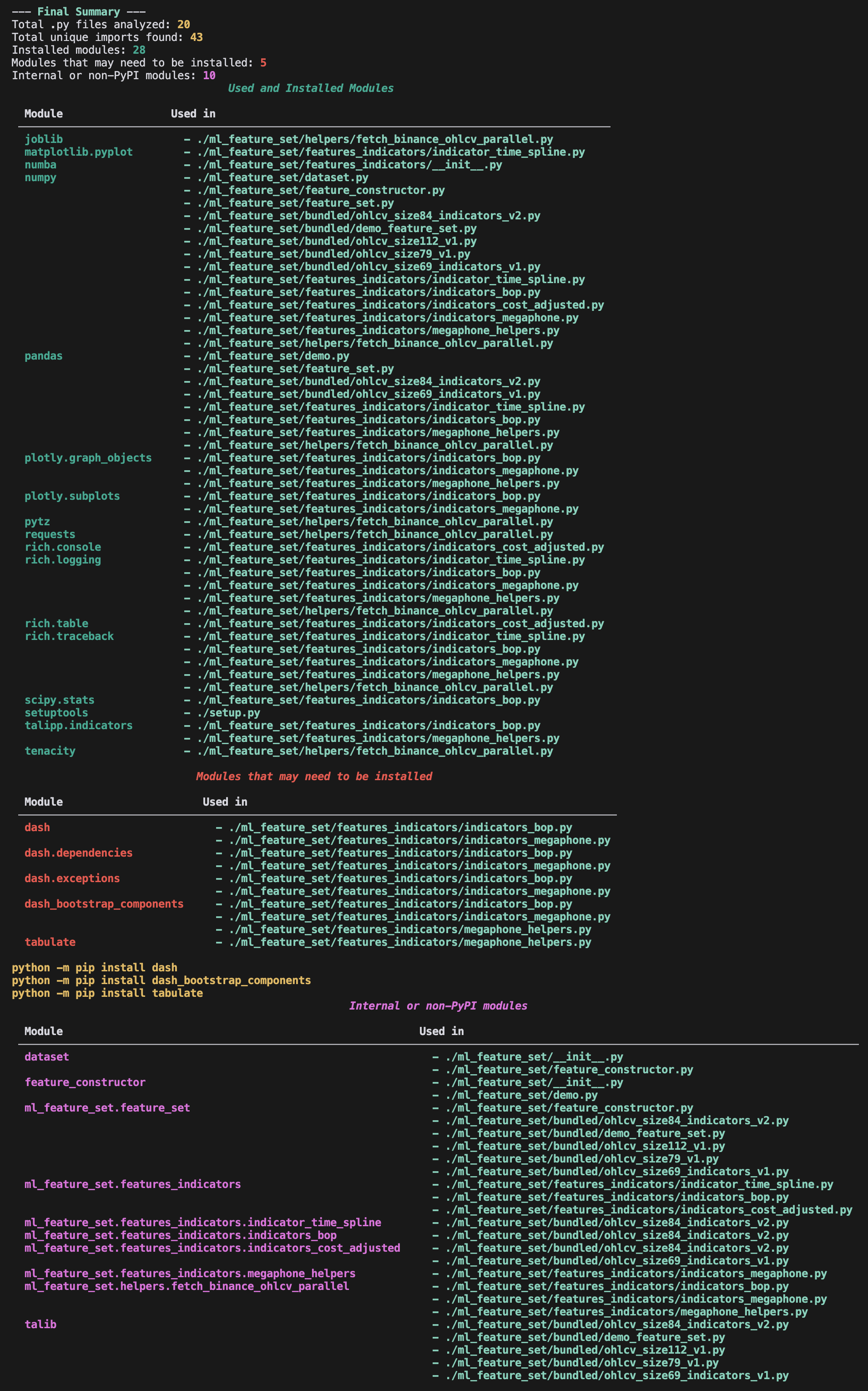
- Generates a summary of installed modules, modules that need to be installed, and internal or non-PyPI modules.
- Provides installation commands for missing modules.
This script is useful for:
- Developers who want to ensure that all necessary Python modules are installed in their virtual environment.
- Teams working on shared projects to maintain consistent development environments.
- Anyone who wants to automate the process of checking and installing project dependencies.
Use this script:
- When setting up a new development environment.
- After pulling changes from a remote repository to ensure all dependencies are installed.
- Periodically, to ensure that your environment remains consistent with your project’s requirements.
This script should be run in the root directory of your Python project. It will analyze all Python files in the current directory and its subdirectories, respecting the .gitignore file to avoid unnecessary checks.
Follow these steps to use the script:
python -c "import subprocessimport sysimport os
def install_package(package_name):    print(f'Installing {package_name}...')    subprocess.check_call([sys.executable, '-m', 'pip', 'install', package_name])
# List of required packagesrequired_packages = ['rich', 'requests', 'pathspec', 'setuptools']
# Install required packages if they're not already installedfor package in required_packages:    try:        __import__(package)    except ImportError:        install_package(package)
# Now that we've ensured the packages are installed, we can import themimport pkg_resourcesimport requestsfrom rich.console import Consolefrom rich.table import Tablefrom rich import boximport pathspecfrom rich.logging import RichHandlerfrom rich.traceback import install as rich_installimport astimport loggingimport importlib
console = Console()
# Mapping of import names to PyPI package namesimport_to_pypi = {    'talib': 'TA-Lib',    # Add more mappings here if needed}
def install_or_upgrade_package(package_name):    try:        # Check if the package is installed        dist = pkg_resources.get_distribution(package_name)        installed_version = dist.version        console.print(f'[bold green]{package_name}[/bold green] is installed with version {installed_version}')
        # Check the latest version available on PyPI        response = requests.get(f'<https://pypi.org/pypi/{package_name}/json>')        response.raise_for_status()        latest_version = response.json()['info']['version']        console.print(f'Latest version of [bold green]{package_name}[/bold green] available is {latest_version}')
        if installed_version != latest_version:            console.print(f'Upgrading [bold green]{package_name}[/bold green] to version {latest_version}...')            subprocess.check_call([sys.executable, '-m', 'pip', 'install', '--upgrade', package_name])        else:            console.print(f'[bold green]{package_name}[/bold green] is already up-to-date.')    except pkg_resources.DistributionNotFound:        console.print(f'[bold red]{package_name}[/bold red] is not installed. Installing...')        subprocess.check_call([sys.executable, '-m', 'pip', 'install', package_name])    except requests.RequestException as e:        console.print(f'[bold red]Error checking latest version of {package_name}: {e}[/bold red]')
def is_module_on_pypi(module_name):    pypi_name = import_to_pypi.get(module_name, module_name)    try:        response = requests.get(f'<https://pypi.org/pypi/{pypi_name}/json>')        response.raise_for_status()        return True    except requests.RequestException:        return False
def find_internal_modules():    internal_modules = set()    for root, dirs, files in os.walk('.'):        for file in files:            if file.endswith('.py'):                module_name = os.path.splitext(file)[0]                internal_modules.add(module_name)        for dir in dirs:            if os.path.exists(os.path.join(root, dir, '__init__.py')):                internal_modules.add(dir)    return internal_modules
# Ensure necessary packages are installed and up-to-datenecessary_packages = ['pathspec', 'rich', 'requests', 'setuptools']for package in necessary_packages:    install_or_upgrade_package(package)
# Setup rich loggingrich_install(show_locals=True)logging.basicConfig(level='DEBUG', format='%(message)s', datefmt='[%X]', handlers=[RichHandler(rich_tracebacks=True, markup=True)])logger = logging.getLogger('rich')
def get_imports(node):    if isinstance(node, ast.Import):        return [n.name for n in node.names]    elif isinstance(node, ast.ImportFrom):        return [node.module] if node.module else []    return []
def analyze_file(file_path):    logger.debug(f'Analyzing file: {file_path}')    try:        with open(file_path, 'r') as file:            content = file.read()        tree = ast.parse(content)        imports = set(module for node in ast.walk(tree) for module in get_imports(node))        logger.info(f'Found {len(imports)} unique imports in {file_path}')        return imports    except Exception as e:        logger.error(f'Error analyzing {file_path}: {str(e)}')        return set()
# Load .gitignore patternsgitignore_path = '.gitignore'if os.path.exists(gitignore_path):    with open(gitignore_path, 'r') as f:        gitignore_patterns = f.read().splitlines()    spec = pathspec.PathSpec.from_lines('gitwildmatch', gitignore_patterns)else:    spec = pathspec.PathSpec([])
all_imports = {}analyzed_files = 0for root, dirs, files in os.walk('.'):    # Filter out ignored directories    dirs[:] = [d for d in dirs if not spec.match_file(os.path.join(root, d))]    for file in files:        file_path = os.path.join(root, file)        if file.endswith('.py') and not spec.match_file(file_path):            imports = analyze_file(file_path)            for imp in imports:                if imp not in all_imports:                    all_imports[imp] = []                all_imports[imp].append(file_path)            analyzed_files += 1
logger.info(f'Total unique imports across all .py files: {len(all_imports)}')
installed_modules = set()not_installed_modules = set()internal_modules = set()used_installed_modules = {}
# Find internal modules firstinternal_module_names = find_internal_modules()
if all_imports:    logger.debug('All imports found:')    for imp in sorted(all_imports.keys()):        logger.debug(imp)        print(imp, file=sys.stdout)  # Print to stdout
    logger.debug('Checking module installation status:')    for imp in sorted(all_imports.keys()):        if imp.split('.')[0] in internal_module_names:            logger.debug(f'{imp} is an internal module')            internal_modules.add(imp)        else:            try:                importlib.import_module(imp.split('.')[0])                logger.debug(f'{imp} is installed')                installed_modules.add(imp)                if imp not in used_installed_modules:                    used_installed_modules[imp] = []                used_installed_modules[imp].extend(all_imports[imp])            except ImportError:                if is_module_on_pypi(imp.split('.')[0]):                    logger.debug(f'{imp} is not installed')                    print(f'{imp} may need to be installed', file=sys.stdout)  # Print to stdout                    not_installed_modules.add(imp)                else:                    logger.debug(f'{imp} is an internal or non-PyPI module')                    internal_modules.add(imp)else:    logger.warning('No imports found in any .py files')
# Get the list of standard library modulesif sys.version_info >= (3, 10):    stdlib_modules = sys.stdlib_module_nameselse:    stdlib_modules = set([        'abc', 'aifc', 'antigravity', 'argparse', 'array', 'ast', 'asynchat', 'asyncio', 'asyncore', 'atexit', 'audioop', 'base64', 'bdb', 'binascii', 'binhex', 'bisect', 'builtins', 'bz2', 'cProfile', 'calendar', 'cgi', 'cgitb', 'chunk', 'cmath', 'cmd', 'code', 'codecs', 'codeop', 'collections', 'colorsys', 'compileall', 'concurrent', 'configparser', 'contextlib', 'contextvars', 'copy', 'copyreg', 'crypt', 'csv', 'ctypes', 'curses', 'dataclasses', 'datetime', 'dbm', 'decimal', 'difflib', 'dis', 'distutils', 'doctest', 'email', 'encodings', 'ensurepip', 'enum', 'errno', 'faulthandler', 'fcntl', 'filecmp', 'fileinput', 'fnmatch', 'formatter', 'fractions', 'ftplib', 'functools', 'gc', 'getopt', 'getpass', 'gettext', 'glob', 'graphlib', 'gzip', 'hashlib', 'heapq', 'hmac', 'html', 'http', 'imaplib', 'imghdr', 'imp', 'importlib', 'inspect', 'io', 'ipaddress', 'itertools', 'json', 'keyword', 'lib2to3', 'linecache', 'locale', 'logging', 'lzma', 'mailbox', 'mailcap', 'marshal', 'math', 'mimetypes', 'mmap', 'modulefinder', 'msilib', 'msvcrt', 'multiprocessing', 'netrc', 'nntplib', 'numbers', 'operator', 'optparse', 'os', 'pathlib', 'pdb', 'pickle', 'pickletools', 'pipes', 'pkgutil', 'platform', 'plistlib', 'poplib', 'posix', 'pprint', 'profile', 'pstats', 'pty', 'pwd', 'py_compile', 'pyclbr', 'pydoc', 'pydoc_data', 'pyexpat', 'queue', 'quopri', 'random', 're', 'readline', 'reprlib', 'resource', 'rlcompleter', 'runpy', 'sched', 'secrets', 'select', 'selectors', 'shelve', 'shlex', 'shutil', 'signal', 'site', 'smtpd', 'smtplib', 'sndhdr', 'socket', 'socketserver', 'sqlite3', 'sre_compile', 'sre_constants', 'sre_parse', 'ssl', 'stat', 'statistics', 'string', 'stringprep', 'struct', 'subprocess', 'sunau', 'symbol', 'symtable', 'sys', 'sysconfig', 'tabnanny', 'tarfile', 'telnetlib', 'tempfile', 'termios', 'test', 'textwrap', 'threading', 'time', 'timeit', 'tkinter', 'token', 'tokenize', 'trace', 'traceback', 'tracemalloc', 'tty', 'turtle', 'turtledemo', 'types', 'typing', 'unicodedata', 'unittest', 'urllib', 'uu', 'uuid', 'venv', 'warnings', 'wave', 'weakref', 'webbrowser', 'winreg', 'winsound', 'wsgiref', 'xdrlib', 'xml', 'xmlrpc', 'zipapp', 'zipfile', 'zipimport', 'zlib', 'zoneinfo'    ])
# Final Summaryconsole.print('\\n--- [bold cyan]Final Summary[/bold cyan] ---')console.print(f'Total .py files analyzed: [bold yellow]{analyzed_files}[/bold yellow]')console.print(f'Total unique imports found: [bold yellow]{len(all_imports)}[/bold yellow]')console.print(f'Installed modules: [bold green]{len(installed_modules)}[/bold green]')console.print(f'Modules that may need to be installed: [bold red]{len(not_installed_modules)}[/bold red]')console.print(f'Internal or non-PyPI modules: [bold magenta]{len(internal_modules)}[/bold magenta]')
if used_installed_modules:    table = Table(title='[bold green]Used and Installed Modules[/bold green]', box=box.SIMPLE)    table.add_column('Module', style='bold green')    table.add_column('Used in', style='bold cyan')    for module in sorted(used_installed_modules.keys()):        if module.split('.')[0] not in stdlib_modules:            file_list = '\\n'.join([f'  - {file_path}' for file_path in used_installed_modules[module]])            table.add_row(module, file_list)    console.print(table)
if not_installed_modules:    table = Table(title='[bold red]Modules that may need to be installed[/bold red]', box=box.SIMPLE)    table.add_column('Module', style='bold red')    table.add_column('Used in', style='bold cyan')    printed_modules = set()    install_commands = []    for module in sorted(not_installed_modules):        base_module = module.split('.')[0]        if base_module not in printed_modules:            install_commands.append(f'[bold yellow]python -m pip install {base_module}[/bold yellow]')            printed_modules.add(base_module)        file_list = '\\n'.join([f'  - {file_path}' for file_path in all_imports[module]])        table.add_row(module, file_list)    console.print(table)    console.print('\\n'.join(install_commands))
if internal_modules:    table = Table(title='[bold magenta]Internal or non-PyPI modules[/bold magenta]', box=box.SIMPLE)    table.add_column('Module', style='bold magenta')    table.add_column('Used in', style='bold cyan')    for module in sorted(internal_modules):        file_list = '\\n'.join([f'  - {file_path}' for file_path in all_imports[module]])        table.add_row(module, file_list)    console.print(table)
if not not_installed_modules and not internal_modules:    console.print('\\n[bold green]All modules are installed.[/bold green]')"
Additional Purposes
Section titled “Additional Purposes”Based on the nature of the script, additional purposes include:
- Dependency Management: Ensuring that all dependencies are installed and up-to-date, which is crucial for maintaining a stable development environment.
- Project Onboarding: Simplifying the process for new developers joining the project by automating the setup of the required environment.
- Continuous Integration: Integrating this script into CI pipelines to automatically check and install missing dependencies before running tests or deploying the application. By following this tutorial, you can ensure that your Python project has all the necessary modules installed, making your development process smoother and more efficient.
Sample output of the snippet on the terminal
Section titled “Sample output of the snippet on the terminal”