Evaluation
Source: Notion | Last edited: 2024-11-16 | ID: ea762177-1b5...
⛓️ Interview Process for All (Step-by-Step)
- Self-Assessment (SA)
- Fast-Track Assessment (FTA)
- Evaluation
- Employment or Partnership
- Base & Bonus Pay or Profit Sharing
🎯 At Eon Labs Ltd., we recognize that downside volatility, or decline from the peak of equity, is an inherent risk in financial trading. We are willing to tolerate this risk, however, only if the upside profit potential, particularly the Excess Gain beyond the peak, is expected to be equal to, if not greater than, the percentage of drawdown and can be reached within a reasonable timeframe.
Evaluation. Past performance can be indicative of future results. Therefore, if you have an existing crypto-algorithmic perpetual futures contract (BTCUSDTPERP or ETHUSDTPERP) trading strategies, use the Binance price data that we shared with you on the Take-Home Assessment (THA) to back-test your strategy. Then, submit the most recent thirty-six (36) months of the simulated backtesting results for Evaluation. The results will also help us parameterize your WBUF key trading performance matrices. The Take-Home Assessment (THA) has no time limit and no due date. You are more than welcome to submit and re-submit your backtesting results to us for consideration as long as this Notion-based recruitment page is still visible to you. Once the results assessed based on the HoH model are satisfactory, you can decide if you want Employment or Partnership. Either way, you’ll become our ATSR and we’ll provide you with an MSA to trade your strategy.
Utility. Three (3) risk management criteria (1, 2, 3) that are detailed in Evaluation are used to come up with the four WBUF metrics (a, b, c, d) for the PFP or Profit Sharing:
-
Investment Time Horizon → a) ITH
-
Minimum Rolling Trading Frequency → b) MRTF
-
Minimum Rolling RRR(H) → c) TMAD
→ d) [TMAEG](/trading/metrics/tmaeg/)Why Do We Evaluate Backtesting Results?
Section titled “Why Do We Evaluate Backtesting Results?”Backtesting or simulated historical trading results can provide insight into the potential performance of a strategy, which is better than having no information at all. However, it is important to note that these results are not always an accurate representation of how the strategy will perform in the real world. Evaluating backtesting results allows us to gain an understanding of how the strategy will fare in various market conditions, and can help us identify potential risks and rewards associated with the strategy.
This evaluation should take into account factors such as the risk-return ratio (RRR), frequency of trades, and the investment time horizon. By considering these factors, it is possible to determine whether the strategy is able to produce a high return with minimal risk.
RRR was first defined and popularized by Dr. Richard CB Johnsson in his investment newsletter (‘A Simple Risk-Return-Ratio’, July 25, 2010).
where and simply refer to the price levels of an equity balance by the start and end of the time period.
The risk is measured as the percentage maximum drawdown of NAV for the specific period:
where , , and refer the drawdown and prices at a specific point in time, , or the time right before that, .
The risk-return ratio is then defined and measured, for a specific time period, as:
Note that dividing a percentage numerator by a percentage denominator renders a single number. This RRR number is a measure of the Excess Gain in terms of risk. It is fully comparable, i.e. it’s possible to compare the RRR for one equity growth of a strategy with the RRR of another strategy, just as long as it’s the same time period.
What if RRR is equal to 1?
Section titled “What if RRR is equal to 1?”For example, if you had a portfolio worth (MDD)80,000. To recoup this loss and break even, you would need to make a gain of 80,000. That is, in order to just enough to recoup a of X%, you need to make a gain of X/(1-X). For example, a loss of 20% requires a gain of 20/(100-20) = 25% to break even. Similarly, a loss of 50% requires a gain of 50/(100-50) = 100% to break even, and so on. When , not only do we have to break even, but also have to gain beyond the peak by X%. If the , X is equal to 20, then the formula (1+X/(1-X))*(1+X) would be equal to (1+20/(100-20)%) * (1+20)% = (1+25%) * (1+20%) = 1.25 * 1.2 = 150%. This means that to recoup a 20% loss and then make an additional gain of 20%, you would need to make a total gain of 50% from the trough. Therefore, the percentage gain from trough needed if RRR = 1:
where is the required percentage of recovery and expansion from the tough if there is an equivalent percentage gain beyond the break-even point.
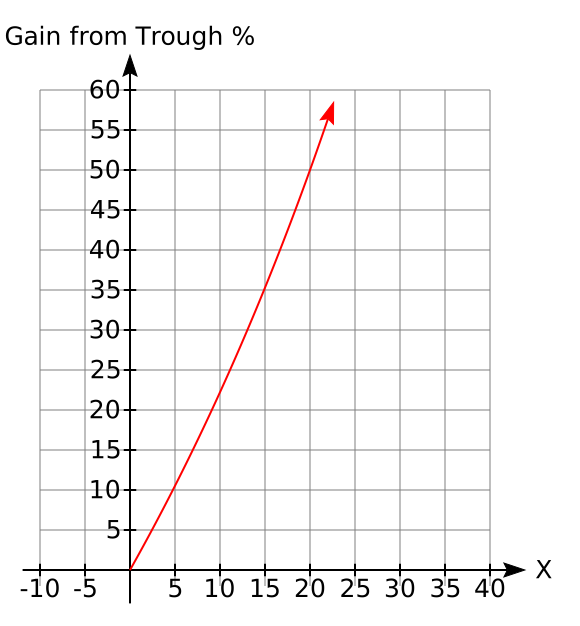
As you can see from the equation graph above that it is quite a challenge to have an because when the needed profit growth percentage beyond the break-even point is required to be equal, if not less than the , the needed percentage gain from the trough is geometrically harder as grow bigger.
Excess Gain as a percentage of ATH must be larger than the MDD as a percentage of ATH in the context of WBUF where RRR is larger than 1.

In addition, it is important to consider the market regime when evaluating backtesting results. This means that it is acceptable if a strategy only performs well in certain periods. By evaluating the results, we can gain insight into how the strategy will perform in different market conditions.
How Do We Evaluate Your Result?
Section titled “How Do We Evaluate Your Result?”Strategies should be crafted to achieve the maximum potential risk-return ratio (RRR) while still allowing for a large amount of trades and a short-term investment time horizon. To assess the time-varying performance, a successive rolling window is utilized to determine the minimal duration of the time horizon in order to maintain a RRR equal or greater than one.
When constructing a strategy, we must consider the tradeoff between risk and return. This means that strategies should be designed to meet a certain risk-return ratio (RRR). We measure RRR using a percentage maximum drawdown (MDD) for a given period, which is defined as the maximum drop in value from peak to trough over that period. The RRR is then calculated by dividing the Excess Gain over the period by the MDD. This number is a measure of the Excess Gain in terms of risk and is fully comparable across strategies.
In addition to considering RRR, we also evaluate a strategy based on its frequency of trades and its investment time horizon. Cathie Wood, CEO and founder of Ark Invest, says she invests on a five-year investment time horizon. At EonLabs, we expect all strategies to have an ultra short-term investment time horizon, where the minimum rolling RRR during the entire backtesting period is equal to or larger than 1, and the investment time horizon is equal to or less than 28 days. This ensures that strategies are able to have a high Excess Gain on investment and remain relatively stable.
Min Rolling RRR(H)
Section titled “Min Rolling RRR(H)”For the submitted backtesting period , we demand the minimal rolling risk-return ratio to be equal or larger than 1:
where is the investment time horizon or the observed length of each sampled successive rolling window during the submitted backtesting period.
It is commonly understood that utilizing larger rolling window sizes in your analysis can result in a more smooth and stable curve. However, our goal is not to simply present a favorable image of your strategy. Instead, we aim to determine the smallest within your backtesting period that still maintains an acceptable level of RRR, meaning .
Investment Time Horizon
Section titled “Investment Time Horizon”Cathie Wood, CEO and founder of Ark Invest, says she invests on a five-year investment time horizon. Wood’s mantra is that ARK invests with a minimum five-year time horizon, and that volatility is to be expected in the industry-disrupting and cutting-edge stocks it targets.
At Eon Labs Ltd., although we expect volatility in your strategy performance, we only accept trading strategies that have short-term ITH, which must satisfy the following criteria: minimum rolling RRR during the entire backtesting period is equal or larger than one (1), where the investment time horizon is equal or less than 28 days.
where is the investment time horizon or the observed length of every rolling window subsample during the submitted backtesting period.
In other words, ITH is the maximum duration required for an investment to not only recover from a drawdown that occurs after reaching an equity peak but also to surpass the peak by a specific percentage. This predetermined percentage must be equal to or greater than the drawdown percentage. In essence, the ITH measures the time it takes for an investment to bounce back and achieve additional growth following a decline in value.
In other words, when you attempt to plot the , you should compress the as much as you can and let’s see how small the can get while maintaining .
Rolling Trading Frequency
Section titled “Rolling Trading Frequency”Increasing the frequency of trades or the number of trades within a specific time period can potentially lead to more statistically significant results for a trading strategy. This is because a larger sample size can provide a clearer picture of the effectiveness of the strategy and help to reduce the impact of any random fluctuations or outliers in performance.
It means that your trading performance evaluation result for the submitted backtesting period :
where is the investment time horizon or the observed length of each sampled successive rolling window during the submitted backtesting period.
Evaluation
Section titled “Evaluation”If all three of the aforementioned criteria are satisfied, please Contact DO and submit the results of your backtesting. It is worth noting that we will also evaluate the performance of your strategy under various market regimes. It is acceptable if your strategy exhibits satisfactory performance during specific market conditions.
Self-Evaluation - A Simplified Approach
Section titled “Self-Evaluation - A Simplified Approach”Ask yourself this: “What is the percentage gain from a trough in what timeframe at I can reasonably expect from my strategy?”
Let’s denote it as
The answer to it can help you determine the maximum drawdown for any given period in the context of how we evaluate your backtesting results from the three criteria mentioned above.
The maximum time that you are allowed to hit a trough or experience a maximum drawdown :
It means that every time your strategy hit a peak, the clock is ticking because it has only to reach a new peak.
Also, as we have learned from above,
where is the required percentage of recovery and expansion from the tough if there is an equivalent percentage gain beyond the break-even point, therefore,
For example, if you can reasonably expect a strategy to gain 30% from a trough in 15 days, that is
your is:
where
Hence, it follows that
Look-up Table
Section titled “Look-up Table”The following look-up table can give you a sense of the kind of percentage of Maximum Drawdown from a peak that your strategy can withstand if it can expectedly generate so much percentage gain from the trough afterward.
Summary
Section titled “Summary”At EonLabs, we evaluate the backtesting performance of a strategy to determine its risk-return ratio, number of trades, and investment time horizon. We measure the risk-return ratio using the maximum drawdown as a percentage over a given period. We expect strategies to have an ultra short-term investment time horizon with a minimum rolling risk-return ratio of 1 over a period of 60 days or less. Additionally, we consider the market conditions under which the strategy is evaluated, thus it is acceptable if a strategy exhibits strong performance during specific market regimes.
⚠️ Caveat. Eh, backtesting over a short period of time can often yield some pretty decent results. We ain’t too worried about that, since we understand that there’s no such thing as a strategy that’ll work in every situation. If you don’t mind, could you run some more tests over different periods and see how it goes? If it’s performing well no matter the conditions, it’s possible that you’ve either found the holy grail or there’s a bug in the algorithm. Those darn bugs in trading algorithms, especially ones with look-ahead bias, can cause astounding results rather than just slight discounts or deviations. 🥶
📍 Recruitment Board 🔑 ** Guest Researcher Area (accessible by invitation only) **🔒
- [LOB Data on S3 🔏](/engineering/integrations/lob-data-on-s3/)- [Algo-Trading Books 🔒](/research/books/algo-trading-books/)🔆 External Links
- [**Link-in-Bio for EonLabs**](https://bit.ly/m/eonlabs)- [**Indeed Company Page**](https://ca.indeed.com/cmp/Eonlabs)- [**EonLabs.com Official Site**](https://www.eonlabs.com/)🍁 EonLabs acknowledges that the land on which we live and work is the unceded traditional territories of the xʷməθkʷəy̓əm (Musqueam Indian Band), Sḵwx̱wú7mesh (Squamish Nation), and səlilwətaɬ (Tsleil-Waututh Nation) and we are grateful for the opportunity to do so.